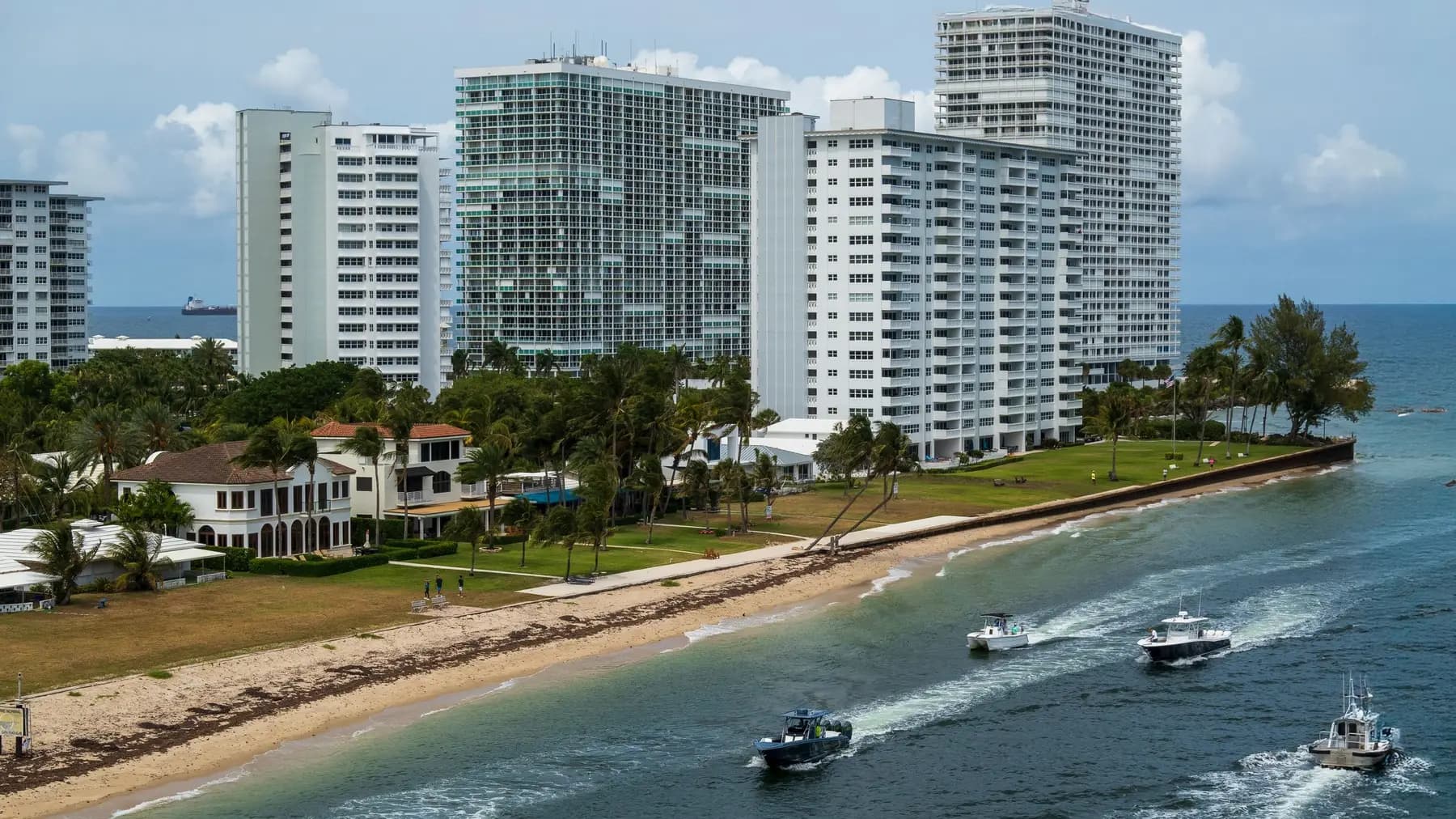
The numbers for the Fort Lauderdale area this year do not describe a boom. In August 2026 the metro had 914,500 payroll jobs, 600 fewer than a year earlier, and the unemployment rate had risen to 4.4% from 4.0% (BLS). Broward's population barely moved in 2025. Prices across the region rose 3.7% over the year.
And yet new towers keep topping out downtown, health systems are building, and some local businesses are having their best years. What's happening isn't a boom or a bust. It's a sorting: growth is concentrating in particular industries, particular customers and particular businesses. We're a Fort Lauderdale marketing and AI agency, and this is the picture we work inside every day. This report follows the evidence on where growth is going, and what it means for anyone trying to win customers here.
Fort Lauderdale isn't booming. It's sorting.
Flat is not the same as weak. Payroll losses narrowed through 2026, from 1.1% year over year in March to 0.1% in August, and Broward's unemployment rate stayed below Florida's 4.6% (BLS). What changed is the mix. The table below shows which sectors added and lost jobs over the past year.
| Sector (Fort Lauderdale metro) | Jobs, Aug 2026 | Change vs Aug 2025 |
|---|---|---|
| Education and health services | 126,400 | +2.6% (about +3,200) |
| Government | 110,300 | +1.1% |
| Manufacturing | 32,800 | +1.2% |
| Construction | 55,100 | +0.9% |
| Leisure and hospitality | 97,200 | +0.5% |
| Financial activities | 71,200 | 0.0% |
| Other services | 35,400 | -1.1% |
| Trade, transportation and utilities | 196,400 | -1.4% (about -2,800) |
| Professional and business services | 171,400 | -1.7% (about -3,000) |
| Information | 18,200 | -2.2% |
Source: BLS Economy at a Glance, August 2026, preliminary, not seasonally adjusted, Fort Lauderdale-Pompano Beach-Deerfield Beach metropolitan division. Approximate job changes are derived from BLS's rounded percentages (current jobs divided by one plus the change).
Two things stand out. Health care alone added more jobs than the next four growing sectors combined. And the sectors that lost the most, trade and professional services, are the ones most exposed to higher rates and to companies doing more with fewer people.
Two kinds of customer in one city
Broward's median single-family home price reached $650,000 in August 2026, up 4%, and sales of homes over $1 million jumped 22.6% (Miami Realtors). At the same time, the Atlanta Fed's September Beige Book described affluent households still spending while lower- and middle-income households trade down and lean on credit (Federal Reserve Bank of Atlanta).
For a local business this is the most important fact in the report. The same city now holds two very different customers. One is comparing three remodelers and will pay for the best. The other is comparing on price and waiting longer to buy. A business that markets to both the same way usually wins neither, and a business that knows which one it serves can aim every page, ad and follow-up at that person.
What it costs to compete here now
Operating costs keep rising faster than revenue for many owners. Regional prices were up 3.7% in August (BLS CPI). One in five Florida small-business owners named insurance cost or availability as their single biggest problem, 11 points above the national average (NFIB via Florida Trend). The Federal Reserve raised rates in September 2026 for the first time since 2023, to 3.75% to 4.00% (Federal Reserve), and 30-year mortgage rates were above 7% at the start of October.
Small businesses carry more of this region than most: they employ 53.6% of workers in the Miami-Fort Lauderdale-West Palm Beach metro, against 45.9% nationally (SBA Office of Advocacy). When margins are squeezed, the first instinct is to cut marketing. The better question is which marketing is producing customers and which is producing traffic that never becomes a job.
More competitors, the same customers
Broward lost 372 residents between 2024 and 2025. Roughly 29,500 more people moved out to other parts of the country than moved in, almost fully offset by international arrivals and births (Census estimates via USAFacts). Meanwhile, the number of businesses competing for those residents kept rising. Business applications in Broward reached 72,422 in 2025, 40% more than in 2019, though 1.4% fewer than in 2024 (Census Business Formation Statistics). Applications are not launches, but the direction is clear.
| Broward establishments | 2019 | 2025 | Change |
|---|---|---|---|
| Ambulatory surgical and emergency centers | 42 | 66 | +57% |
| Mental health practitioners | 269 | 501 | +86% |
| Dental offices | 992 | 1,110 | +12% |
| Home health care | 399 | 449 | +13% |
| HVAC, plumbing and electrical contractors | 1,629 | 1,811 | +11% |
| Residential remodelers | 614 | 809 | +32% |
Source: BLS Quarterly Census of Employment and Wages, Broward County, annual establishment counts, 2019 and 2025. Our comparison: establishment growth against a flat population (see research notes).
Put those two facts side by side and the picture for a dentist, a surgery center or an HVAC company is plain. There are more of you, and not more customers. The ones growing are taking customers from someone else, usually at the moment that customer searches, compares and decides who to call.
Healthcare is growing, and consolidating
Health care is where the jobs are, but not evenly. Nationally, the share of physicians in private practice fell to 42.2% in 2024 from 60.1% in 2012 (AMA, via Medical Economics). In Broward, physician-office employment fell about 13% between 2019 and 2025 while hospital employment grew, and Broward Health is building its first new medical office tower in 25 years on South Andrews Avenue (Commercial Observer). We read that as consolidation, though the data can't prove why jobs moved. For an independent practice, it means competing with systems that have bigger brands and referral networks, which makes being found and chosen directly by patients more important, not less.
What patients weigh is not what most practice websites lead with. In a University of Michigan national poll of adults 50 to 80, 93% rated insurance acceptance very important, and 61% appointment wait time, while about 20% said the same of online ratings (Annals of Internal Medicine, 2021). Insurance, availability and location belong at the top of the page.
Five local shifts worth watching
- The airport is resetting. Spirit Airlines ceased operations in May 2026; it had carried about 31% of FLL's passengers in 2024 (WLRN). FLL traffic fell 8.5% in 2025 to 32.2 million (Broward County). Expect fewer budget leisure visitors near term; resident-serving businesses are less exposed.
- The port is strong. Port Everglades handled a record roughly 4.77 million cruise passengers in fiscal 2025, up 16% (Cruise Industry News), and the region drew 20.9 million visitors in 2025 (Visit Lauderdale).
- Conventions have a new anchor. The 801-room Omni opened in December 2025 with the expanded Broward County Convention Center (Broward County).
- Downtown keeps densifying. FAT Village, a roughly $500 million mixed-use project in Flagler Village with the city's first mass-timber office, is expected to deliver between late 2026 and 2027 (Florida YIMBY).
- Investment is still arriving. The Greater Fort Lauderdale Alliance reported $272 million in new capital investment won in fiscal 2026 through May (GFL Alliance).
None of these guarantees more customers for a given business. A new tower adds residents who need dentists, contractors and restaurants, but only the businesses those residents can find, and trust, will see them.
How customers decide who to call
Customers are pickier and look at more places before they call. In BrightLocal's 2026 consumer survey, 41% said they always read reviews (up from 29%), 31% will only use a business rated 4.5 stars or higher (up from 17%), and 74% care only about reviews from the last three months (BrightLocal, vendor survey). The same survey found Google's share of local review reading fell to 71% from 83% as AI tools rose to 45% from 6%.
In practice a Fort Lauderdale customer now checks a few things in quick succession: who shows up in Maps and search, how recent and specific the reviews are, whether the website answers their actual question (insurance, price range, service area, availability), and how fast someone responds. A business can lose at any of those steps.
AI is changing how customers find you, not why they choose you
AI summaries are taking clicks. When Google showed an AI summary, users clicked a regular result in 8% of visits, against 15% when there was none (Pew Research Center, 2025), and Ahrefs measured a 58% lower click-through rate for the top-ranking page when an AI Overview appears (Ahrefs, 2026).
But the claim that AI replaces search for local businesses doesn't hold up. Google states that there is nothing special to do to appear in AI Overviews or AI Mode beyond sound SEO (Google Search Central). The assistants draw on the same signals: a complete Google Business Profile, recent reviews, and pages that answer specific questions clearly. The businesses AI recommends tend to be the ones that were already easy to verify. And 61% of Florida small businesses already use an AI platform themselves (U.S. Chamber of Commerce), so using AI is no longer an edge on its own. The edge is being the business the assistants can verify and recommend, which is what AI search optimization work is for: making sure your profile, reviews and pages give ChatGPT, Gemini and Google's AI a clear answer that names you.
Your website is where market share is won or lost
Everything above points to the same place. In a market where the customer base isn't growing and competitors keep multiplying, growth comes from winning share, and most of that decision now happens on a phone, in the minute between finding a business and choosing one. That makes the website less of a brochure and more of the place where the sale is decided. The sites that win customers here are built around how people actually choose: they answer the questions that matter to the right customer, prove trust quickly, and make the next step effortless.
- Built for the customer you want. A practice chasing the affluent buyer leads with quality and availability; one serving price-sensitive households leads with clarity on cost and insurance.
- A page for every service people search for, and for the towns you actually serve, so you can be found for each one and not just your name.
- The deciding questions answered up front: insurance accepted, typical pricing, service area, how soon you can come.
- Trust at the moment of choice: recent reviews, real project photos, credentials, a local phone number.
- One clear next step on every phone screen, with a form short enough to finish.
- Tracking from first click to booked job, so every marketing dollar is judged on revenue, not visits.
That is the approach we took with All Glass 4 U, a family glass contractor serving the Treasure Coast through Broward. Rebuilding the site and the tracking around how their customers choose, alongside local and AI search work, organic traffic is up more than 500% since September 2024 (SEMrush), and the company has expanded south with a second location in Deerfield Beach.
Where marketing budgets leak: after the click
Most wasted marketing money isn't wasted on the ad. It's lost after the customer has already raised their hand. Following one customer from search to booked job, the leaks are predictable.
| Stage | Where it leaks | What the evidence says |
|---|---|---|
| Visibility | Not in Maps or AI answers for the services you sell | AI tools now used by 45% for local recommendations (BrightLocal) |
| Trust | Old or thin reviews; unclear site | 31% require 4.5+ stars; 74% want reviews from the last 3 months (BrightLocal) |
| Inquiry | Ads sending people to a generic page | Average Google Ads cost per click $5.42; cost per lead $66.69 (WordStream, 2026) |
| Response | Unanswered calls, slow follow-up | 44% of inbound business calls missed (Invoca, vendor); leads contacted within an hour about 7x likelier to qualify (HBR) |
| Customer | No tracking from lead to job | Without it, budgets follow clicks instead of revenue |
At an average of roughly $67 per lead, a missed call is not a small thing. A business that lets a third of its calls ring out is paying full price for leads it never speaks to. When we review a local business's marketing, this is usually where we start, because it is often the cheapest growth available: an AI receptionist or missed-call text back so no inquiry goes unanswered, automated follow-up so leads hear back in minutes, and call tracking so every dollar can be traced to a booked job.
How to choose a marketing partner in Fort Lauderdale
There is no shortage of agencies in South Florida. Rather than rank them, here are the questions worth asking any of them, including us.
- Will they report on calls, bookings and revenue by source, not just traffic and rankings?
- Do the ad accounts, Google profile, website and data belong to you, in your name?
- Can they show live work and real results you can check yourself?
- Do they understand your local market: neighborhoods, service areas, insurance, seasonality?
- Will they fix what happens after the click: response time, call handling, follow-up?
- Can you leave month to month if it isn't working?
We hold ourselves to the same list. Our clients own their accounts and data, see results in a live reporting dashboard, and can check our work for themselves. If you're comparing partners, use these questions with everyone, including us.
What to plan for in 2027
What the evidence supports: a slow-growth regional economy, continued strength in health care, steady tourism and port activity, cost pressure from insurance and rates, and more competitors in most local service categories. What's uncertain: how fast air traffic recovers after Spirit, how far rates rise, and how quickly AI assistants change the way people pick a business.
In that environment the businesses best positioned for 2027 are the ones that know which customer they serve, show up clearly wherever that customer looks, and answer first. Visibility is only the beginning. Trust, response and tracking are what turn it into revenue.
About this report
This report draws on public data from the Bureau of Labor Statistics, the Census Bureau, the Federal Reserve and local agencies, plus clearly labeled industry surveys. Figures cover the Fort Lauderdale metropolitan division or Broward County as noted; city-level business data is not published for most measures. Vendor research is identified as such. We conducted no interviews or site visits for this report. We plan to update it annually as new data is released. ProWay Digital is a Fort Lauderdale marketing and AI agency for businesses ready to scale, building websites, SEO, Google Ads and the systems that answer, follow up and track every lead.
Related: marketing in Fort Lauderdale, local SEO, AI search optimization, Google Ads and Local Services, missed-call text back.